
Will Carpet Cleaning Remove Furniture Marks and Dents?
In most cases, yes — professional cleaning can noticeably lift furniture indentations, but how much recovery you’ll actually see depends on how long the dent has been there, the carpet’s fiber type, and the pile height. Fresh marks respond best. Marks that have sat under heavy furniture for years may only partially improve. We give you an honest answer during pre-inspection, before any work starts — not after.
If you’ve just moved a couch, rearranged a bedroom, or you’re staging a Medford home for sale, you’ve probably noticed the deep, stubborn rows and squares pressed into the carpet where furniture legs used to sit. It’s one of the most common questions we hear on pre-inspection calls across the Rogue Valley: can this actually be fixed, or is the carpet just going to look like this forever? This guide goes past the quick yes-or-no and explains the actual science of why furniture marks happen, what determines whether yours will bounce back, how different carpet fiber types behave, and what you should (and shouldn’t) do before you call anyone.
For the general mechanics of how our appointments work, including the raking step that helps restore compressed pile, see our 7-step cleaning process. If a mark turns out to be permanent, we’ll talk about repair-side options like patching, covered on our carpet repair page.
The Fiber Compression Science — Why Furniture Marks Happen
Why does a heavy dresser leave a permanent dent while a chair you move every week leaves nothing at all?
Carpet pile is built to spring back. Each fiber has what’s called elastic memory — a built-in tendency to return to its original upright position after being flattened by foot traffic, a vacuum, or a piece of furniture. Under normal daily use, that memory does its job: you walk across the room, the pile bends, and within minutes to hours it recovers. Furniture is a different story because the pressure is constant, concentrated on a tiny footprint (a chair leg or caster), and sustained for weeks, months, or years without relief.
At the microscopic level, sustained compression forces the fiber’s internal structure — the crimp and twist that gives carpet its bounce — to flatten and, over time, to take a “set.” Early on, that set is reversible: moisture and heat reintroduce enough flexibility for the fiber to relax back toward its original shape. That’s essentially what a hot water extraction cleaning does at 195°F, combined with the raking step already part of our process, which lifts and redistributes crushed pile so the fibers stand back up rather than drying flat. The longer the compression sits, though, the more the fiber’s internal structure adapts to the flattened position permanently, and heat and moisture alone stop being enough to reverse it.
This is really a race between two forces: how much “spring” is still left in the fiber’s memory versus how long and how hard it’s been held down. That’s the entire question we’re answering at pre-inspection when we look at a furniture mark — not whether cleaning in general works, but where a specific mark falls on that spectrum.
What Determines Whether a Furniture Mark Will Recover
We look at five factors before giving you a straight answer. None of them alone tells the whole story — it’s the combination that predicts how much a mark will lift.
1. Duration of Compression
Under about 3 months, most marks recover well. Between 3 months and a year, recovery is usually partial but visible. Beyond a year or two under the same piece of furniture, the fiber has often taken a permanent set and full recovery isn’t realistic.
2. Weight Applied
A floor lamp leaves almost nothing. A loaded bookshelf, piano, or waterbed frame concentrates enormous pressure on a small footprint and compresses fiber structure far more aggressively, even in a shorter window of time.
3. Pile Height and Density
Taller, denser pile has more fiber mass and more elastic memory to work with, so it tends to spring back further. Low, dense builder-grade carpet has less material to recover, so marks can look deeper even from lighter furniture.
4. Moisture History
Carpet that’s been kept reasonably dry retains more of its original resilience. Carpet that’s had repeated water exposure, humidity swings, or prior over-wetting from DIY cleaning attempts tends to lose elasticity faster, which limits how far it can spring back.
5. Fiber Type
Nylon, polyester, olefin, and wool all respond differently to compression and to heat-and-moisture recovery. This matters enough that it deserves its own section below.
How Different Carpet Fibers Respond to Furniture Marks
Does it actually matter what your carpet is made of when it comes to furniture dents? Yes, significantly — fiber type is often the single biggest predictor of recovery after duration of compression.
Nylon has the best natural elastic memory of the common residential fibers. It resists permanent crushing and responds well to heat and moisture, which is why nylon carpet holds up best under furniture over time. A lot of the newer builds we see in East Medford and Central Point use nylon, and those homes generally show the best mark recovery even after moderate compression periods.
Polyester feels soft and looks great when new, but it has moderate resilience — it compresses more easily than nylon and its recovery, while still real, tends to be less complete on marks that have sat for a long time. It’s an extremely common fiber in mid-range Medford homes built or re-carpeted over the last decade.
Olefin (polypropylene) has the lowest resilience of the four. It’s inexpensive, common in rental-grade carpet across White City and other rental-heavy areas of Jackson County, and it tends to hold compression marks more stubbornly because the fiber itself doesn’t have much spring to begin with, even when it’s relatively new.
Wool is variable. Natural wool fiber actually has excellent inherent elastic memory and can recover impressively well, but older wool carpet — the kind you’ll still find in some of the historic homes around Jacksonville — may have lost some of that resilience simply from age and decades of wear, independent of any one piece of furniture. On older wool, we set expectations carefully rather than promising a like-new result.
Fresh Mark, Old Dent, or Permanent Damage? What to Expect
How do you know which category your carpet’s marks fall into before you even book anything? Here’s the honest breakdown we use on pre-inspection walk-throughs.
Fresh Mark (Furniture Moved Recently, Under a Few Months)
Expectation: High likelihood of near-complete recovery.
What we do: Standard hot water extraction with attention to raking the affected area, allowing heat and moisture to relax the fiber back toward its original position.
Result: Most fresh marks are dramatically less visible, often close to unnoticeable, once fully dry.
Medium-Age Mark (Several Months to a Couple of Years)
Expectation: Partial, visible improvement rather than full disappearance.
What we do: The same heat-and-extraction process, sometimes with extra attention and dwell time on the compressed area, but we won’t oversell what fiber that’s partially set can do.
Result: Noticeably softer and less defined marks; the outline may remain faintly visible depending on fiber type and pile.
Permanent Set (Years Under the Same Furniture, or Very Low-Resilience Fiber)
Expectation: Limited change from cleaning alone — the fiber structure itself has adapted to the flattened position.
What we do: We’ll say so plainly rather than charge you for a result cleaning can’t deliver, and point you toward alternatives.
Result: If the mark matters for resale or appearance, patching or a small repair may be the more realistic fix — see our carpet repair page for what that looks like.
What Homeowners Can Try Before Calling — and What to Avoid
Is there anything worth trying yourself before you book a cleaning appointment? A few small things help; a few popular internet tricks can actually make things worse.
- 1
Do: Move the furniture off the mark now
The sooner weight comes off, the sooner the fiber’s elastic memory can start working on its own, even before a cleaning appointment.
- 2
Do: Give it 24–48 hours before judging
Some rebound happens naturally just from relieved pressure and normal room humidity. Don’t assume a mark is permanent the same day you move the furniture.
- 3
Do: Gently brush or fluff the pile by hand
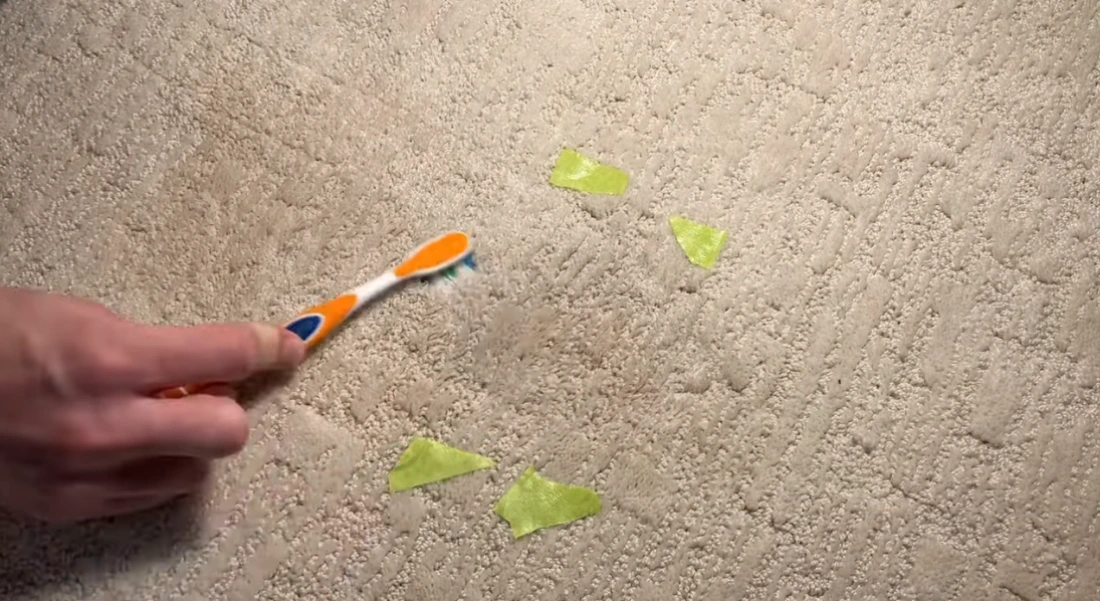
A soft brush or even your fingers, worked gently against the direction of the flattened pile, can help loosen the compressed fibers without damaging them.
- 4
Don’t: Use the “ice cube method”
You’ve likely seen this online — place an ice cube on the dent and let it melt, supposedly rehydrating the fiber as it recovers. We don’t recommend it for Medford homes. Slow, localized melting can push moisture down into padding and subfloor rather than lifting the fiber, and in winter especially, that trapped moisture in an unheated or poorly ventilated area can sit long enough to invite mildew or subfloor issues rather than actually fixing the dent. A brief, even application of heat and moisture during a real cleaning does the job far more effectively and without the risk.
- 5
Don’t: Scrub aggressively or over-vacuum the spot
Hard scrubbing or repeated heavy vacuuming over a compressed area can fray or break fibers that are already stressed, turning a recoverable mark into visible fiber damage.
⚠ If the mark is more than just flattened pile — if you notice the carpet backing showing through, fibers that feel brittle or broken, or a permanent color change — that’s fiber damage, not just compression, and it needs to be assessed differently. We’ll flag this honestly during pre-inspection rather than treating it as a routine cleaning fix.
Furniture Mark Scenarios We See in Medford and Jackson County
Furniture marks come up in a handful of very specific situations across the Rogue Valley, and each one has slightly different stakes and timelines.
Rental Move-Outs (White City, West Medford, Phoenix-Talent, Central Point)
Tenants preparing to move out often worry that furniture indentations from a couch or bed frame will be flagged during a walk-through. In most cases, ordinary furniture compression is treated as normal wear, not damage — and cleaning can help minimize marks before the final inspection. If a deposit dispute does come up, our related guide on carpet cleaning and Oregon security deposit deductions covers what landlords can and can’t reasonably charge for.
Pre-Listing Home Staging
Sellers rearranging or staging furniture ahead of showings want carpet looking as fresh as possible. Since staging often means moving pieces that have sat in one spot for years, we’re upfront about which marks are likely to lift and which are better addressed by simply arranging furniture to cover a stubborn spot for photos and showings.
Historic Jacksonville Homes
Older homes in Jacksonville sometimes still have original or long-installed wool or wool-blend carpet in select rooms, alongside decades of furniture that’s rarely been rearranged. These cases benefit from a careful, conservative approach — testing recovery on a small area before committing to a full room treatment plan.
New Construction Move-In (Eagle Point, Central Point)
New homeowners in growing neighborhoods around Eagle Point and Central Point sometimes see faint marks appear surprisingly fast, within the first few weeks of moving in furniture. New carpet padding can still be settling, and fresh nylon or polyester fiber generally responds very well to an early cleaning that includes raking, before any compression has a chance to set further.
Furniture Mark FAQ — Medford, Oregon
Furniture Marks? Let Us Assess Before You Decide.
We’ll look at the specific marks in your home during pre-inspection and give you an honest expectation — before any cleaning starts, not after. Call (458) 302-0101 — Mon–Fri 8am–6pm, Sat 9am–4pm
← All Blog Posts